
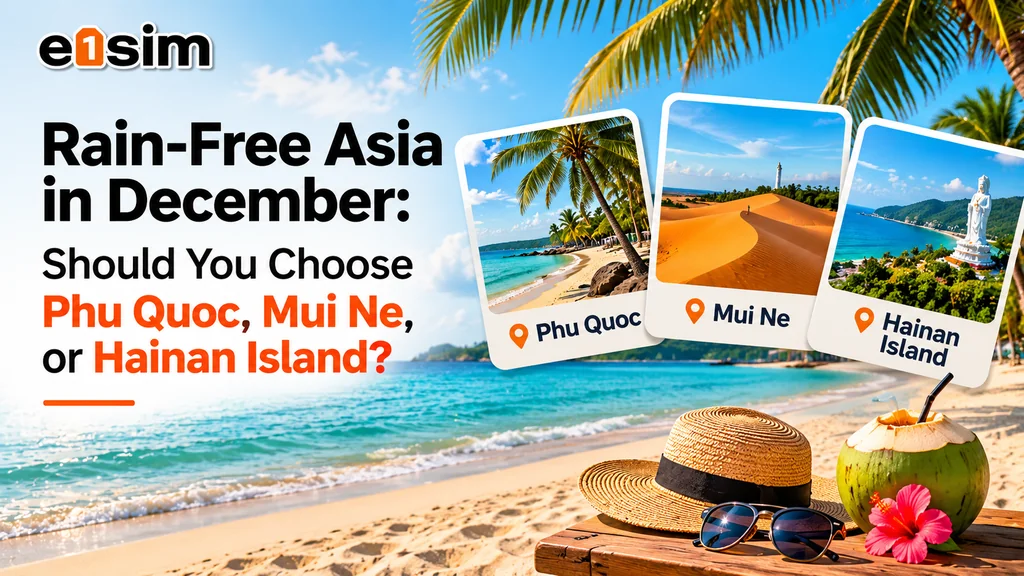
December is ideal for Phu Quoc, Mui Ne and Hainan. Find out why central Vietnam is rainy and the south is sunny. How to buy eSIM for internet in Asia.
December is an ideal month for traveling to Southeast Asia, but not all resorts are equally good at this time of year. While central Vietnam (Nha Trang, Da Nang) is experiencing the rainy season and storm waves, Phuquoc Island, Mui Ne beaches and Chinese Hainan shine with sun and offer calm seas. In this article, we'll figure out where to go in early winter if you want guaranteed good weather, comfortable rest and optimal prices. We'll compare three destinations by climate, cost, infrastructure and tell you how to stay connected in an unfamiliar country.
Why December is a rainy month in central Vietnam
Many tourists plan a trip to Nha Trang or Da Nang in December, mistakenly believing this is the beginning of high season. In reality, the northeast monsoon at this time brings heavy precipitation, especially on the central coast. Waves reach 2–3 meters, the sea is murky, and the sky is overcast.
December in central Vietnam is a transitional month. Rains begin in October-November and continue until January. Precipitation comes in waves: several hours of heavy downpour, then a break. The temperature stays around 24–26 °C, which is more pleasant than summer heat, but sunny days are rare. Beach holidays during this period become a lottery.
Phuquoc and Mui Ne: sunny December and calm seas
A completely different picture on the southwestern coast of Vietnam. Phuquoc and Mui Ne in December are in the middle of the dry season — this is an ideal time for beach holidays.
Phuquoc Island: white beaches and eternal summer
Phuquoc is Vietnam's largest island, located in the Gulf of Siam. In December, there is clear weather here, and the temperature of water and air stays at 28–30 °C. The sea is calm, visibility is excellent, waves are minimal.
The island is famous for its white sand beaches, snorkeling islands and fishing spots. Phuquoc is home to the resort villages of Duong Dong and An Thoi, which have well-developed tourist infrastructure. You'll find hotels for any budget here: from budget guesthouses (10–15 USD per night) to five-star resorts (150–300 USD).
Phuquoc is ideal for families with children: shallow sea near the shore, gradual entry into the water, safe. The island has diving schools, snorkeling tours, water parks. Food is cheap (lunch at a cafe 2–4 USD), water transport between beaches is accessible.
Mui Ne: eternal winds and singing dunes
Mui Ne is a small coastal town on the southeastern coast of Vietnam, 240 km from Ho Chi Minh City. In December, it has one of the best weather of the year: 29–31 °C, almost no precipitation, northeast wind is soft and stable.
Mui Ne is famous for its unique landscape: red and white dunes, fishing villages, crystal clear water. This destination is loved by kitesurfers because the constant wind creates ideal conditions for the sport.
Accommodation in Mui Ne is cheaper than on Phuquoc: a mid-range hotel room costs 25–50 USD per night. But the infrastructure is less developed — Mui Ne is more suitable for travelers looking for seclusion and adventure than for comfortable rest.
Hainan: Chinese tropical paradise with hot springs
Hainan Island in southern China has long been positioned as the Eastern Hawaii. It's a tropical paradise with its own visa-free program for many tourists, thermal springs and traditional Chinese medicine centers.
Climate and weather in December
In December on Hainan +24–28 °C, the sea is calm, precipitation is minimal. This is the beginning of high season, when crowds of tourists from mainland China come to escape the cold. The climate is milder than in Vietnam, but more humid (although there is little rain in December).
Popular bays and resorts
Dadonghai — a modern beach resort with a high concentration of hotels and tourists. It has a good beach, amusement parks, restaurants, active nightlife. Accommodation is more expensive: a mid-range hotel 80–120 USD per night.
Yalong Bay — a quieter and more eco-friendly alternative. The beach is wider, less crowded, nature is better preserved. Prices are slightly higher, but rest is more relaxed. Water sports are popular here.
Sanya Bay — a developing resort on the western coast. Cheaper than Dadonghai and Yalong Bay, but infrastructure is developing. Ideal for budget travelers.
Unique offer: hot springs and traditional medicine
Hainan is known for its natural thermal springs (hot water comes from the earth at depths of up to 70 meters). The island has traditional Chinese medicine centers that offer herbal treatment procedures, acupuncture and therapeutic massage.
This attracts tourists looking not only for beach holidays, but also for health improvement. A spa and traditional medicine program costs 2–3 times less than in European countries.
Visa exemptions
One of Hainan's main advantages is a visa-free entry program for citizens of more than 50 countries (including many CIS countries under certain conditions). No visa is required if you arrive at Haikou or Sanya airport and plan to stay no more than 30 days. This simplifies trip planning.
Comparative table: prices and infrastructure
| Criteria | Phuquoc | Mui Ne | Hainan |
|---|---|---|---|
| Temperature in December | 28–30 °C | 29–31 °C | 24–28 °C |
| Number of sunny days | 25–28 | 25–28 | 20–22 |
| Hotel (night, mid-range) | 40–70 USD | 25–50 USD | 80–120 USD |
| Food at cafe | 2–4 USD | 2–3 USD | 4–8 USD |
| Taxi package to airport | 10–15 USD | 5–10 USD | 15–25 USD |
| Infrastructure for families | Excellent | Good | Excellent |
| Language barrier | Medium | Medium | High |
| Additional services | Snorkeling, diving | Kitesurfing, dunes | Hot springs, TCM |
How to stay connected in Asia: eSIM as a solution to language barriers
Mobile internet while traveling is not a luxury, but a necessity. This is especially important in Vietnam and China, where the language barrier is noticeable, and popular messengers (WhatsApp, Google Maps) require a stable connection.
Why eSIM is better than a physical SIM card
Traditional scheme: you arrive in the country, go to the market or store, buy a local SIM card, spend time registering it. At the same time, you lose access to your main number, and switching between cards is inconvenient.
eSIM (embedded digital SIM) solves these problems:
- It is processed in advance, at home, via the Internet
- Does not require physical card exchange
- You remain available on your main number
- You can activate multiple profiles for different countries
- Works on all modern smartphones (iPhone XS and newer, most Samsung flagships, Google Pixel, etc.)
How to buy eSIM at e1sim.com
Step 1: Visit e1sim.com 2–3 weeks before your flight.
Step 2: Select your country (Vietnam or China). If you plan to travel through several countries, get a regional "Asia" or "Southeast Asia" package — it's cheaper than buying separate plans.
Step 3: Choose data volume and validity period. For 7–10 days of travel, usually 10–15 GB is enough.
Step 4: Pay by card. An activation QR code will be sent to your email.
Step 5: Install eSIM in advance (not necessarily on departure day) through your phone settings by scanning the QR code. The profile will be ready for activation.
Step 6: After landing, simply switch to eSIM in settings — the internet will work within a minute.
Why eSIM is needed specifically in Asia
Navigation: Google Maps doesn't work in China (requires VPN), but mobile eSIM internet is needed for local apps (Baidu Maps, WeChat).
Translator: Google Translate, Yandex.Translator — these apps require stable internet to translate from camera, text on signs.
Taxi and delivery: In China, they use Didi Chuxing, in Vietnam — Grab. Without internet, you won't order transport and food.
WeChat Pay and other payments: In mainland China, cash is a thing of the past. People pay through WeChat Pay and Alipay. This requires internet.
Communication with loved ones: Telegram, WhatsApp, Viber — all of this requires mobile internet.
By choosing eSIM at e1sim.com, you save time searching for a local SIM card, avoid bureaucracy and pay a fair price without tourist middleman markups.
How to choose between Phuquoc, Mui Ne and Hainan
Choose Phuquoc if: - You're traveling with children (shallow sea, developed infrastructure) - You want classic beach holidays with water sports - You're looking for a balance between price and comfort - Interested in sea excursions and snorkeling
Choose Mui Ne if: - You're looking for seclusion and adventure - You're into kitesurfing or surfing - You want to save on accommodation - You like unusual landscapes (dunes, fishing villages)
Choose Hainan if: - You want to combine beach holidays with health improvement (spa, thermal springs) - You're traveling by car or willing to pay higher prices for services - You're interested in traditional Chinese medicine - You value high-quality infrastructure and European-level service
Conclusion: the choice is yours
In December, all three destinations offer good weather, but in different ways. Phuquoc and Mui Ne are Vietnam, cheapness, simplicity and friendliness of locals. Hainan is China, modernity, wellness programs and visa exemptions.
Before your flight, don't forget to purchase eSIM at e1sim.com — it will be your protection against language barriers and unforeseen situations. Mobile internet works everywhere, prices are fair, and connection takes just a couple of clicks.
December is a time for decisive action. If you've decided to go to Asia, choose a destination and book. The weather won't let you down.
Key takeaways:
- Monsoons: Central Vietnam (Nha Trang, Da Nang) in December is experiencing the rainy season. Phuquoc, Mui Ne and Hainan are in the dry season.
- Temperature: Phuquoc and Mui Ne are warmer (28–31 °C), Hainan is milder (24–28 °C).
- Prices: Mui Ne is the cheapest destination, Hainan is the most expensive, Phuquoc is a golden middle.
- Infrastructure: Phuquoc and Hainan are better for families, Mui Ne for adventurers.
- eSIM at e1sim.com: Critical for navigation, translations, taxi orders and payments in Asia. It is processed in advance and does not require changing a physical card.