
Faroe Islands eSIM
11 plans available
∞ Unlimited plans
Best eSIM for Faroe Islands
Compare 11 prepaid eSIM plans for Faroe Islands starting from €3.40. Instant QR code delivery by email, activation in under 2 minutes, no roaming fees and no contracts.
Mobile Networks & Coverage in the Faroe Islands
e1sim Faroe Islands plans run on Vodafone Faroe Islands — one of the archipelago's main mobile operators — with 4G LTE coverage across the inhabited islands. Tórshavn, the capital and largest town on Streymoy island, has excellent 4G coverage across the harbour area, the old town, Tórsgøta (the historic main street), the government district and the main residential areas. Vágar island — home to the international airport and the famous Sørvágsvatn lake optical illusion — has 4G coverage at the airport, in the village of Sørvágur and along the main road. Eysturoy, Suðuroy, Klaksvík on Borðoy and the other inhabited islands all have 4G LTE coverage in their main towns and along main roads.
The Faroe Islands' remote hiking routes, sea cliffs and uninhabited islands naturally have more limited coverage. The island of Mykines — the westernmost island with its famous puffin colony and lighthouse — has limited coverage in the main village and may have no signal on the hiking trail to the lighthouse. The Slættaratindur summit (880 m, the highest point in the Faroe Islands) on Eysturoy has limited signal. Boat trips between islands generally maintain coverage in sight of the inhabited shores. The underwater sea tunnels connecting the main islands (including the 11 km Eysturoyartunnilin ring road tunnel) have maintained 4G coverage through most of their length.
Tórshavn, Sørvágsvatn & the Wild North Atlantic Archipelago
The Faroe Islands is an autonomous territory of the Kingdom of Denmark, consisting of 18 islands in the North Atlantic between Norway, Iceland and Scotland, at approximately 62° north latitude. With a land area of 1,399 square kilometres and a population of approximately 55,000, the Faroe Islands is one of the most sparsely populated territories in Europe. The islands rise dramatically from the North Atlantic as green volcanic plateaux topped by dramatic cliffs, often wreathed in mist and clouds — the islands receive over 260 days of precipitation per year, and their changeable weather is a defining characteristic. Faroese (Føroyskt) and Danish are the official languages; the Faroese people have maintained a distinct culture, language and identity through centuries of Danish rule, and since 1948 the islands have had broad autonomy in internal affairs, though they remain outside the EU. The economy is dominated by fishing and aquaculture — particularly salmon farming, which accounts for the majority of export revenue — and increasingly by tourism and creative industries. Tórshavn, the capital, is one of the smallest capitals in the world by population (around 22,000 inhabitants): a charming harbour city of colourful turf-roofed historic buildings in Tinganes (the oldest part of the city, where the Faroese parliament has met since the Viking age) and modern residential development climbing the surrounding hillsides.
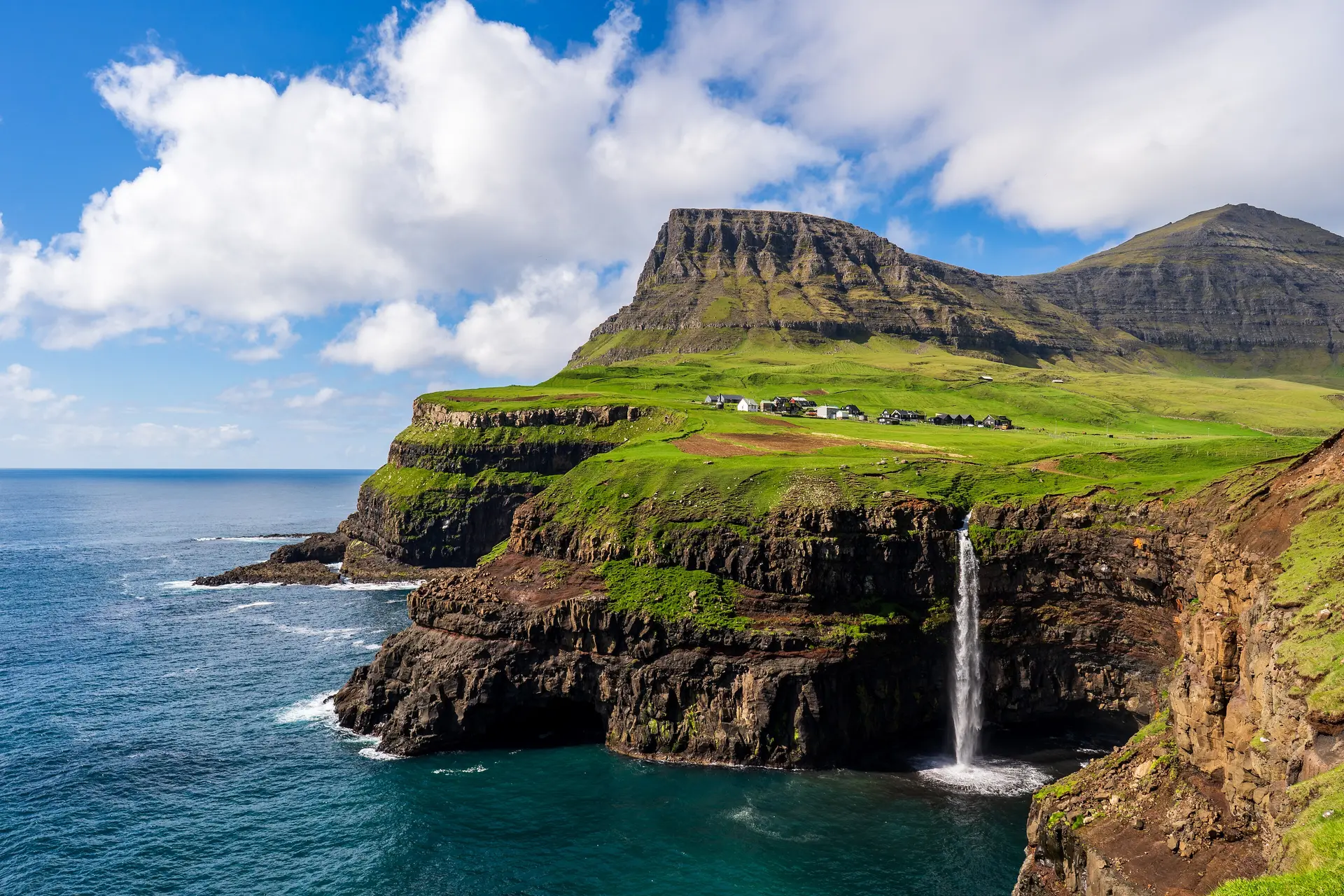
The Faroe Islands have become one of the most sought-after destinations for dramatic landscape photography and hiking in Europe, and the archipelago's relatively recent tourism boom has brought global attention to its extraordinarily scenic terrain. Sørvágsvatn (also called Leitisvatn) on Vágar island is the Faroe Islands' most famous single viewpoint: a lake that appears, from a particular cliff-top angle, to float above the ocean far below it — an optical illusion created by the lake's position on a cliff edge with the ocean visible in the background at a lower elevation. The approach to this viewpoint requires a 3 km walk from Sørvágur village. The Gásadalur waterfall on Vágar — which cascades directly over a cliff into the ocean — is similarly one of the most photographed natural features in the North Atlantic. Múlafossur, as it is also known, was long accessible only by an extremely difficult mountain path until a tunnel opened in 2004 connecting the formerly isolated village of Gásadalur to the road network.
The sea cliffs of the Faroe Islands are among the most dramatic in Europe. The Vestmanna bird cliffs on Streymoy — accessible by boat tour from Vestmanna village — rise 480 metres vertically from the sea and host nesting colonies of kittiwakes, guillemots, razorbills, fulmars and puffins in their countless ledges and caves. Mykines, the westernmost island (accessible by helicopter or ferry from Sørvágur when weather permits), has one of Europe's largest Atlantic puffin colonies and a lighthouse accessible by a spectacular suspension bridge crossing. The island of Kalsoy — reached by ferry from Klaksvík — offers a dramatic hike to the Kallur lighthouse on its northern tip, with views back across the sound to Kunoy island's knife-edge ridgeline. The Faroe Islands' traditional rowing boat races (the sixareens/skeiðar), the Ólavsøka national holiday in Tórshavn (late July), the Faroese chain dance and the G! Music Festival on Gøta are highlights of the cultural calendar.
eSIM vs Roaming in the Faroe Islands
The Faroe Islands is part of the Kingdom of Denmark but sits outside the EU and its roaming zone. This means UK, EU and international carrier roaming rates apply in full — EU carriers charge international European rates for the Faroes at typically €2–5 per day for data add-ons. The islands are also not part of the Nordic roaming agreements that apply between the Nordic EU member states. An e1sim prepaid plan on Vodafone Faroe Islands provides a fixed data allowance on the local 4G LTE network at a transparent prepaid price, without the risk of unexpectedly high bills during an island-hopping trip.
Physical SIM cards from Vodafone Faroe Islands (formerly Faroese Telecom/Vodafone) and Hema are available in Tórshavn. However, purchasing an eSIM before departure is far more practical: scan the QR code before your flight to Vágar and data activates when you land. Plans are data-only; voice calls and messaging run over WhatsApp and iMessage, which are standard across the islands.
Why Choose e1sim for Faroe Islands?

Instant Activation
Scan a QR code and go online in minutes — no physical SIM needed

Best Prices
Transparent pricing with no hidden fees or roaming surprises

Unlimited Data
Unlimited data plans available — browse, stream and work without limits

Premium Network
4G/LTE on top local carriers — fast and reliable everywhere you travel
Explore Faroe Islands with e1sim

Tórshavn
The world's smallest capital charms with turf-roofed houses, harbor views and a proud Viking past

Sørvágsvatn Lake
An optical illusion lake appears to float high above the ocean — one of Earth's most surreal landscapes

Gásadalur & Múlafossur Waterfall
A remote cliff-top village where a waterfall plunges directly into the Atlantic far below